

Struggling to get hardware cloth securely attached to your wooden frame? It can be tricky to get it just right, but with the right steps, you’ll create a tight, durable barrier.
You’ll learn how to measure, cut, and fasten the mesh effectively to ensure it stays in place and keeps pests out.
Ready to master this simple project? Keep reading for the full step-by-step guide.
How to Measure and Cut Hardware Cloth for Your Wood Frame
To measure and cut hardware cloth for your wood frame, start by accurately recording the height and width of each section with a tape measure. Include every individual panel if the frame has multiple openings. Precise measurement ensures you buy enough material and prevents shortfalls. Always add a small amount—about half an inch—to each measurement to allow for overlap and secure fastening. When ordering your material, remember that straight run chickens will require a secure enclosure free of gaps.
Lay the hardware cloth flat on a stable surface and mark your cut lines clearly. Align your marks with the mesh grid, cutting at wire intersections for a cleaner edge. Using diagonal or wire cutters, cut slowly and carefully to keep the cloth stable and avoid shifting. This method works best when you cut at wire intersections to prevent fraying and keep the mesh intact. After cutting, trim any sharp wire ends to prevent injury and make installation safer. Before attaching the hardware cloth to your frame, test-fit the piece to make sure it fits well. Wear gloves and eye protection during the entire process to stay safe from sharp wire ends and flying debris. For best results, use diagonal cutters designed for clean wire cutting, as described in the guide on wire cutters.

High-Quality Anti-Rust Process This hardware cloth is made from high-strength low-carbon steel wire, combining excellent strength with flexibility. After precision welding, the entire product undergoes a premium anti-rust treatment—hot-dip galvanization—with special reinforcement at all seams and corrosion-prone areas to ensure uniform, dense coating and outstanding rust resistance. This process grants the product superior weather resistance, making it an ideal choice for wire mesh fencing and long-term outdoor applications.

Galvanized hardware cloth roll 48 inches x 50 foot with 1/2 inch mesh 19 gauge.

Material and size: The size of the hardware cloth is 16 inch×50 ft and 1/2 inch×1/2 inch thickness, adopt 19 guage hot-dipped galvanized material
Which Fastener Works Best for Your Wood Type and Project Size
Galvanized staples are best for softwood frames like pine or cedar when tackling small projects. They install quickly and are ideal for lightweight panels or garden beds, spaced every 2 to 3 inches along edges. For projects requiring high strength or high-tension resistance, screws with washers provide better durability. They distribute pressure more evenly and help prevent pull-through under stress. For chicken coop applications, consider top chicken toys to enrich the coop environment while securing the structure. When mixing your own grit, using crushed granite as a material can further reduce costs for the flock. For larger mobile coops, choosing the right wheels for chicken tractors is essential for easy movement and structural stability.
When working with hardwood frames such as oak or maple, always opt for screws paired with fender washers. Pre-drilling pilot holes prevents splitting, especially with dense woods. The wide washers increase clamping force, ensuring the fasteners hold securely over time. This combination is best suited for rigid mesh attachments or structural components that need to stay tightly fastened.
For small-scale projects, staples can save time and money. For larger endeavors like coops or aviaries, screws with washers become essential. They provide stronger clamping over longer spans, with spacing generally every 3 to 6 inches, and are easier to remove if future adjustments are needed.

Package includes 200 pcs steel Fencing Staples to meet your daily needs. Wire: approx. Ø 2.3 mm / length: 25 mm / width: 14 mm

Package Includes: You will get 280pcs hot diopped galvanized U shaped nails, For Wire OD:1/4" ; Leg Length:1"; Diameter: 0.09"; providing an ample supply for various fencing and securing projects

Premium Material: wire staples are made of high-quality carbon steel with a galvanized surface, making it resistant to oxidation and rust, breakage, and deformation, enhancing durability and maintaining high performance even in harsh environments.
How to Tension Hardware Cloth Without Tearing the Mesh
To tension hardware cloth without tearing the mesh, start by securing one top edge first before working toward the opposite side. Use a come-along or ratchet strap to gradually pull the mesh in small, controlled increments. This prevents distortion of the mesh grid and keeps it aligned. Avoid jerking or applying sudden force; instead, proceed slowly to ensure even tension across the entire length. Clamp the sides in place before making final fastenings, and spread the tension evenly from the center outward. Stop tightening once the mesh lays flat and snug—there is no need to over-tighten. For long-lasting predator defense, selecting a galvanized steel material resists rust and corrosion in outdoor conditions. Regularly check for puckers or bowing, and adjust or rework stressed areas rather than forcing more tension. Angle your staples slightly to grip without pinching the wires, and use washers under fasteners to distribute the load more evenly. Leave a slight amount of slack in cold weather to accommodate metal contraction and prevent stress on fasteners when temperatures drop. For predator-proofing, ensure the mesh gauge thickness matches the durability required by top-rated chicken coops. Consider that just as balanced nutrition is crucial for duckling health when feeding treats, proper mesh strength is equally vital for security.

ATTENTION: Please Read: Our hardware cloth is 20 feet long, 4 inches wide, wire 23 gauge thick and holes 1/4 inch. Please confirm the size before placing the order

Galvanized After Welding: Hot-dip galvanized after welding coats every welded joint, so the heavy duty mesh resists rust and breakage far longer than pre-galvanized wire in rain, soil, and sun.Thicker wire builds a sturdier fence that resists bending and animal push-through

Premium Heavy-Duty Construction: Crafted from high-quality low-carbon steel wire with hot-dip galvanized coating applied after welding for maximum durability. Our 1/4" 23-gauge hardware cloth (12" x 35ft roll) offers exceptional strength while remaining flexible enough for easy installation. Resists breaking, bending, and warping for long-lasting performance
Staple and Screw Spacing for Hardware Cloth Perimeters
Staple spacing should be 2 to 3 inches along the perimeter to ensure a secure hold when fastening hardware cloth to a wood frame. If the frame is especially stable and the mesh lightweight, you can widen the spacing to up to 4 inches. For screws, place them every 6 to 12 inches; for added strength, stick closer to 6 inches. Concentrate additional fasteners at the corners, where perimeter stress is highest. Start fastening at one corner, then work from the center outward along each edge to maintain proper mesh tension and prevent sagging. Consistent spacing helps prevent uneven pull, which can cause localized loosening over time. When using staples, ensure they penetrate the wood by at least 1/2 inch. For screws, pairing them with washers provides extra grip and prevents pull-through. Following this pattern keeps the hardware cloth tight and uniformly secured. For additional predator resistance, consider treating the adjacent ground with ag lime for chicken coop to deter odors and pests. If you are building a compost enclosure with this mesh, using heat from BSFL activity can further discourage predators and speed waste breakdown. To speed up cleanup of the enclosure, removing any decaying organic matter promptly will prevent attracting unwanted pests.

𝐑𝐞𝐮𝐬𝐚𝐛𝐥𝐞 𝐅𝐞𝐧𝐜𝐞 𝐍𝐚𝐢𝐥: Fence staples for wire fencing are made of 304 stainless steel material, anti-rust and anti-corrosion, easy to install or remove with a power drill, allow repositioning.
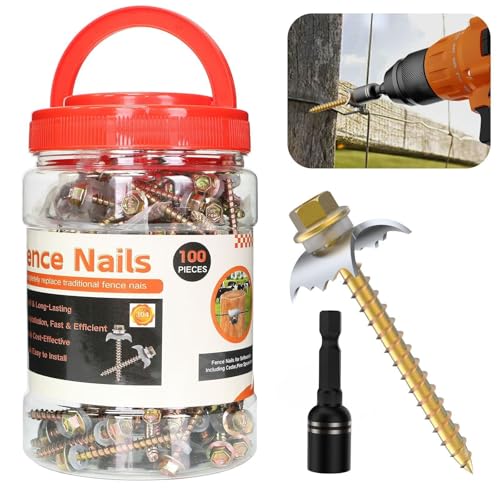
Premium 304 Stainless Steel Fence Nails— Rust-Proof & Durable: These Fence Fasteners are crafted from high-grade 304 stainless steel, resisting corrosion, rust, and weathering—ideal for outdoor use in gardens, farms, or coastal areas. Withstands rain, UV rays, and extreme temperatures, ensuring long-term stability for your fence or DIY Fence Supplies projects

🛡️ Pre-Assembled for Instant Use & Time-Saving Unlike loose u nails or disassembled fencing hardware, our heavy-duty fence staples come with wood screws perfectly pre-assembled into dual-tooth stamped metal parts. Simply take them out of the box and start installing immediately, eliminating tedious prep work and cutting your on-site working time in half.
When to Add Washers, Wood Strips, or Extra Overlap
Add washers at stress points like corners, centers of sides, and high-tension sections to distribute clamping force and prevent screws from pulling through mesh or sinking into soft wood. Washers help spread pressure over a larger area, reducing damage and increase hold strength. Use them whenever screws are subjected to significant tension or movement, especially on edges or joints under load. For example, quail egg incubators often require this reinforcement to prevent mesh failure from vibration. Similarly, using pine shavings in a coop reduces the risk of respiratory irritation when the wood is properly kiln-dried to remove harmful phenols.
For continuous edge clamping and a cleaner appearance, place wood strips over cut edges. These strips distribute pressure evenly along the entire edge, preventing snagging and providing a neater finish without relying solely on individual fasteners. They also help hide rough or uneven cut edges for a polished look. This technique mirrors the value of a well-built top chicken feeder that relies on consistent pressure distribution for durability.
When joining separate mesh pieces, use an overlap technique to ensure a secure connection. Overlap seams by 4 to 6 inches to prevent gaps or intrusion issues. Extend sheets 1 to 2 inches beyond small frames to create a margin that keeps the mesh flat and resistant to pull-through. Combining washers with overlap helps maintain mesh tension and prevents shifting, while pairing strips with overlap offers a fully covered, clamped seam for added durability.

【Washers for Screws】- This assortment set includes 900 pieces of stainless steel flat washers for screws and bolts. It comes in 9 different sizes: M2 (210 pcs), M2.5 (210 pcs), M3 (200 pcs), M4 (110 pcs), M5 (80 pcs), M6 (42 pcs), M8 (28 pcs), M10 (10 pcs), and M12 (10 pcs). With a total of 900 pieces and 9 different sizes, this fender washers assortment set kit can meet all your different needs.

【Durable 304 Stainless Steel】–Crafted from 304 stainless steel, these washers offer strong corrosion resistance and high hardness for long-lasting performance. They are built to maintain reliability in demanding conditions like rain, humidity, and high temperatures.

MATERIAL COMPATIBILITY & WARNINGS: Ideal for thickness of 1-3 mm materials like leather, paper, cardstock, and thin tarps. Designed for decorative, light-duty use. CRITICAL WARNING: NOT SUITABLE FOR FOAM BOARD, FABRIC, OR CLOTH. These soft, thick materials cannot provide the necessary support for the tool, preventing the jaws from closing properly and risking damage to the pliers' handle
How to Trim Sharp Edges and Finish the Installation
To safely trim sharp edges and finish the installation, follow these steps. First, ensure that the cloth or mesh is completely fastened before trimming excess wire to keep edges aligned. Wear safety glasses and heavy gloves to protect yourself from potential injuries.
Using wire cutters, carefully snip off any loose or excess wire. Always bend the cut ends back toward the frame with pliers to eliminate exposed points that could cause injuries or snags. After bending the wire, tuck or fold the sharp tips inward to smooth the edge. For a long-lasting solution, consider using a heat lamp bulb that matches the enclosure’s durability requirements. Chicks typically use a brooder plate for 2 to 6 weeks, depending on their age and feathering, before transitioning to ambient heat. Choosing galvanized hardware cloth is essential because it resists rust and corrosion over time.
For a cleaner and more finished appearance, add decorative edging such as wood trim over the cut edge. This not only covers the sharp wire but also reinforces the mesh. Secure the trim with staples or tacks, ensuring they are flush with the surface to prevent catching on fabric or skin.
Recheck all edges for stray tips or rough spots. Choose galvanized material for the trim and wire, as it offers better resistance to corrosion and weathering. Before completing the project, verify that no points can catch on skin or fabric, and ensure all edges are smooth and safe to handle.
How to Test Your Hardware Cloth for Strength and Security
To test your hardware cloth for strength and security, start with a thorough visual inspection. Look for loose sections, bowed areas, or gaps between the cloth and the wood. Ensure the mesh lies flat without ripples and check that perimeter edges are not frayed or broken. Confirm that the mesh openings are uniform and that there are no stretched sections, which could weaken the overall structure. This is similar to checking poultry nutrition when avoiding feeding adult layer feed to young chickens, as proper sizing and fit prevent long-term issues. For a flock of this size, ensuring your mesh can withstand the pressure of 30 chickens is critical to preventing escapes and predator attacks.
Next, examine all fasteners—staples, screws, or washers—and verify they are fully seated against the wood. Confirm that clamp placement is snug and that edge fasteners prevent the cloth from lifting or shifting. Rotate each fastener head to test for backing-out, and look for signs of pull-through around staples or washers, especially near corners where stress is higher.
Perform a basic pull test by applying controlled force perpendicular to the surface. Measure any movement at both the center and edges of the panel. Watch for mesh slippage or fastener separation, which indicates points of weakness. Press on the center of the cloth to evaluate deflection—comparing how much it moves helps you identify less secure areas. Ensure the mesh springs back after pressure is relieved to confirm compatibility with your frame. Mark any weak sections for reinforcement to improve strength and reliability.
Why Hardware Cloth Fails Early (and How to Prevent It)
Moisture, abrasion, and environmental stress are leading causes of early hardware cloth failure. Moisture causes zinc to oxidize and erode, especially when the mesh remains damp against wet soil or trapped debris. Prevent corrosion by keeping the cloth dry and improving drainage, such as installing a slight slope or layers of gravel beneath it. Cut edges and installation abrasions strip away zinc coating, exposing bare metal to corrosion. Using hot-dip galvanized mesh provides better durability, and protecting all exposed edges with sealants or flexible coatings adds extra defense. In coastal or high-humidity environments, salt and pollutants can accelerate galvanized deterioration, reducing lifespan to as little as 5 to 10 years. In these areas, stainless steel hardware cloth is a smarter, longer-lasting choice. Pay close attention to corners and seams—gaps here can trap moisture and attract animal pressure. Burying edges fully, overlapping seams, and tightening fasteners are crucial steps to prevent wear and moisture entry. Choosing the right material and maintaining proactive care significantly extends the service life of your hardware cloth.